Why Is There Standing Water in My Yard?
A soggy patch that won’t dry out can mean a dozen different things — but if it’s sitting over or near your septic system, it’s worth ruling out the septic causes first. Here’s how to tell the difference and what each one means.
The Common Answer, and What It Skips
Most people’s first guess is drainage — a low spot, bad grading, a downspout emptying in the wrong place. That’s a reasonable place to start, and it’s right more often than not. Simple grading problems are the single most common cause of a wet yard, septic or no septic.
What that answer leaves out is location. A wet spot near a downspout or at the bottom of a slope is almost certainly just water finding its way there. A wet spot over your drain field, or one that shows up along with an odor, is a different situation entirely — and treating it like a landscaping problem can mean months of a failing system going unaddressed while the actual cause gets worse.
Sign 1: The Water Sits Directly Over Your Drain Field
This is the single biggest tell. If you know roughly where your drain field is — usually a rectangular area 10 to 25 feet from the house — and the wet patch lines up with it, septic failure moves to the top of the list. Effluent that can’t filter down through the soil starts working its way back up instead, which shows up as standing water even without any rain.
In Berks County specifically, this happens more than in flatter, sandier parts of the country. Central and western Berks sit on limestone bedrock, and the karst conditions that come with it — uneven rock depth, unpredictable underground drainage — can leave a drain field with less usable soil than it was designed around. Properties near creeks or the Schuylkill River deal with a related but separate issue: a higher water table that shrinks the buffer between the field and saturated ground.
Sign 2: It Doesn’t Dry Out Even After Several Dry Days
Rainwater drains, evaporates, or gets absorbed within a day or two under normal conditions. A patch that’s still wet a week after the last rain isn’t behaving like surface runoff — it’s being fed by something underneath, and effluent that isn’t filtering properly is one of the most likely sources.
A useful gut check: walk your whole property after a stretch of dry weather and see which wet spots remain. Anywhere still damp that isn’t shaded or low-lying deserves a closer look.
Sign 3: The Grass Is Noticeably Greener or More Lush in That Spot
Effluent is nutrient-rich, so grass growing over a struggling drain field often outgrows the rest of the lawn, even when the ground looks dry on the surface. If you’ve noticed a patch that needs mowing more often than the rest of the yard, or stays a deeper green through a dry spell that’s browning everything else, that’s worth connecting to the wet-spot pattern rather than treating as a separate, unrelated observation.
Sign 4: There’s a Sewage Smell, Even a Faint One
This is the sign that removes most of the ambiguity. Standing water from drainage or irrigation doesn’t smell like sewage. Standing water from a struggling drain field often does, even faintly — especially right after the tank has been used heavily, like after a load of laundry or a full house of guests.
If you smell something and see wet ground in the same spot, that combination is a strong enough signal to stop guessing and get it looked at.
Sign 5: Drains Inside the House Are Acting Up Too
A drain field that can’t accept more effluent eventually backs pressure up through the whole system. If the yard is wet and you’ve also noticed slow drains, gurgling, or a toilet that takes longer to refill than it used to, those aren’t a coincidence — they’re the same underlying problem showing up in two places at once.
Not sure if your yard is telling you something?
We’ll walk the field and give you a straight answer.
Schedule a Drain Field Evaluation
Serving Reading and all of Greater Reading.
What’s Actually Happening Underground
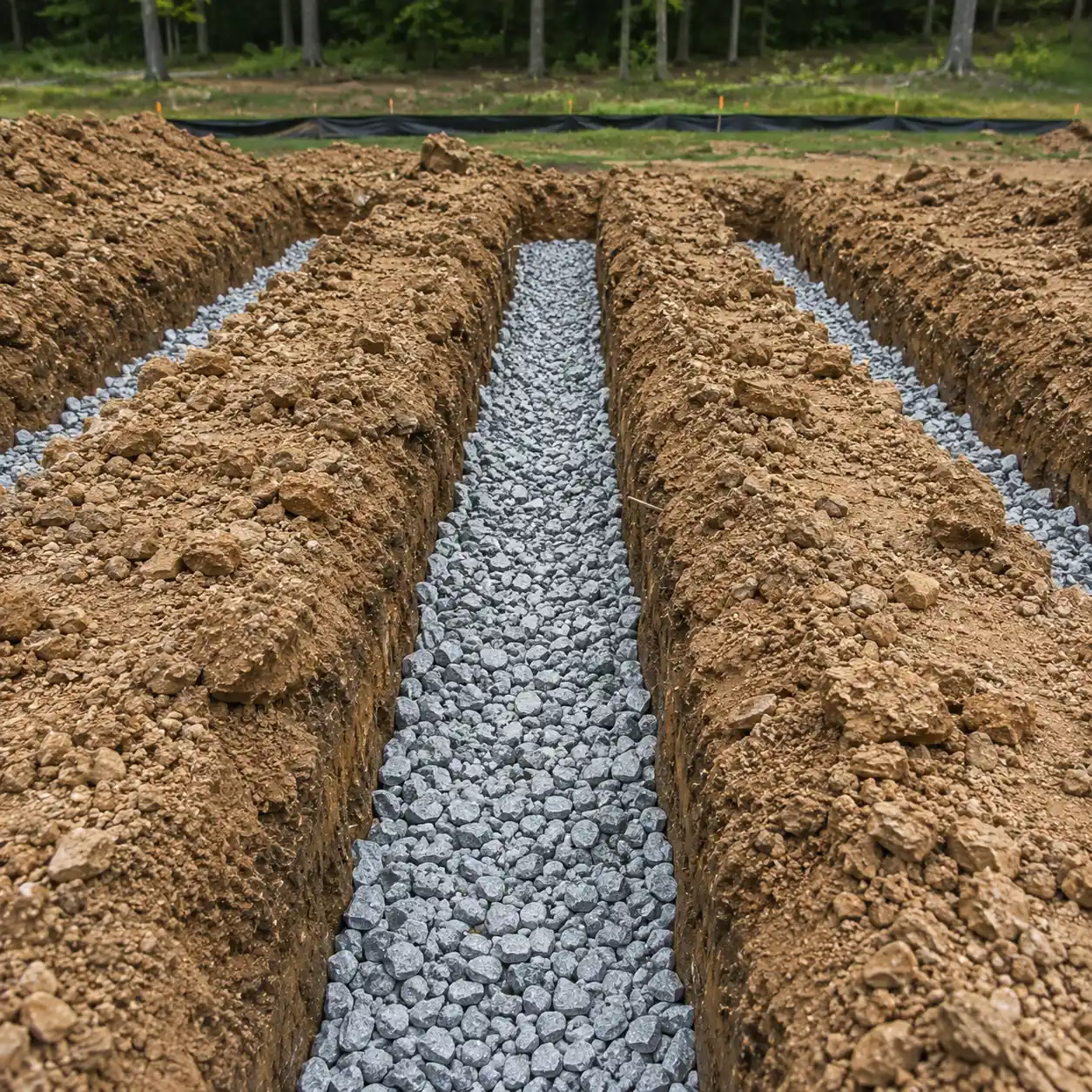
Two mechanisms usually explain the septic version of this problem, and they call for different fixes. The first is a distribution box issue — the small box that splits effluent evenly across your field’s trenches. If it cracks, clogs, or tilts, one section of the field can get flooded with more than its share while the rest stays dry, which shows up as a wet patch in one specific area rather than the whole yard. This is often a same-day, relatively inexpensive repair once it’s diagnosed.
The second is broader soil saturation across the whole field — the ground itself has lost its ability to absorb and filter effluent, whether from age, overload, or the karst and high-water-table conditions common in parts of Berks County. This is a bigger job, sometimes a partial rebuild and sometimes a full replacement, but it’s still worth confirming which situation you’re actually in before assuming the worst.
What to Do Next
Don’t run more water through the system than you have to while you’re waiting to get it looked at — that means spacing out laundry loads and holding off on anything water-intensive. It won’t fix the underlying issue, but it buys you some breathing room and reduces the odds of an actual backup while you wait.
Beyond that, the fastest way to know what you’re dealing with is a direct evaluation — walking the field, checking the distribution box, and probing the soil rather than guessing from the surface. That’s the only way to tell a $400 fix from a much bigger one, and it’s usually quicker than the uncertainty of watching a wet patch and hoping it goes away on its own.
Get Your Drain Field Checked
Tell us where the water is showing up and how long it’s been there, and we’ll follow up to schedule a look.
- Full drain field walkthrough
- Distribution box inspection
- Soil probing on karst-prone lots
- Written findings before any repair
- Serving all of Greater Reading
Tell Us About Your Needs
We’ll reach out to confirm your appointment details.