Slow Drains in Every Sink at Once: Clog or Something Bigger?
One slow drain is almost always local. Every drain in the house slowing down at the same time is a different pattern entirely — here’s how to read it.
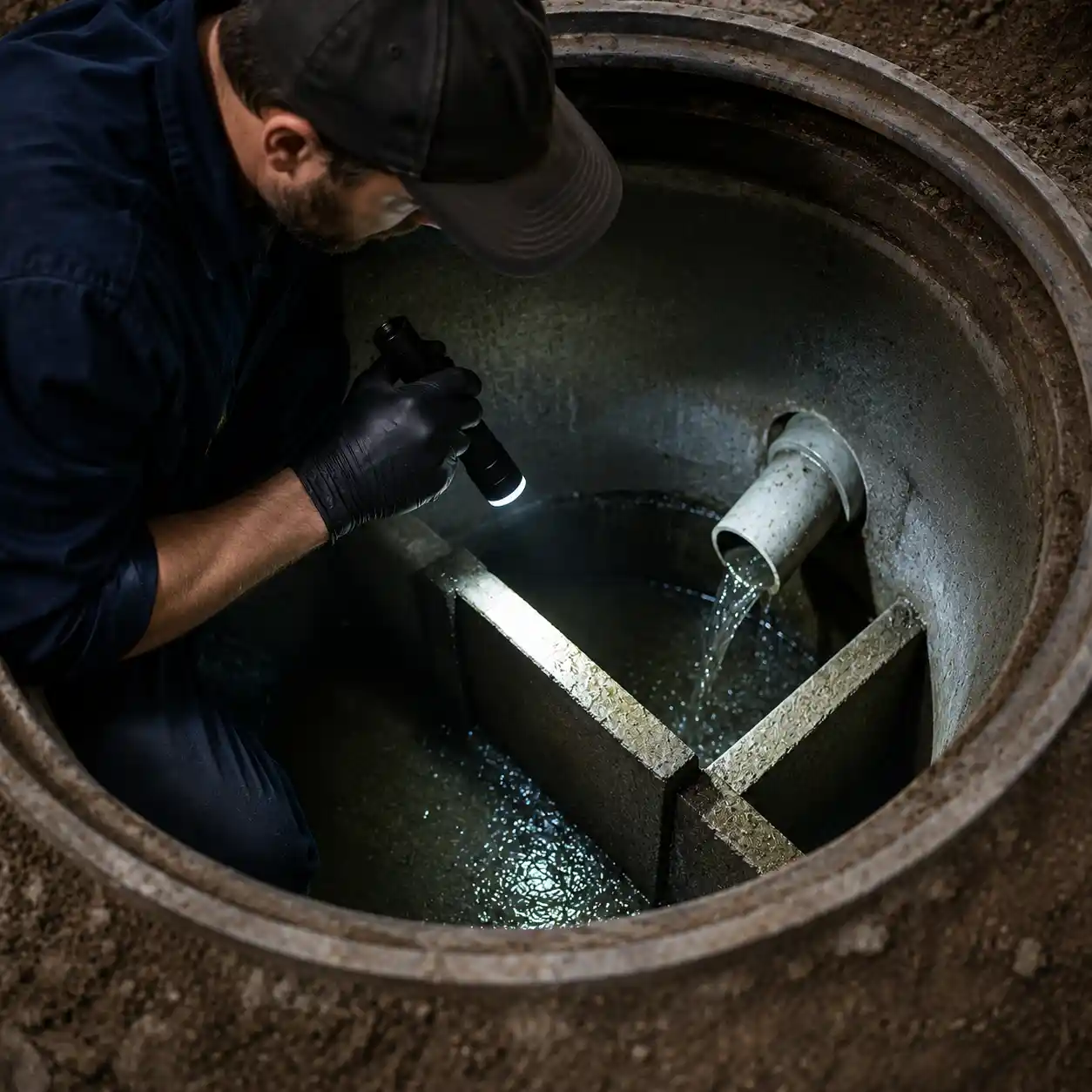
The Single Question That Matters Most
A slow bathroom sink is usually hair and soap scum in that specific drain — a local, easily fixed problem. The question that actually tells you something is whether it’s isolated or system-wide. If your kitchen sink, bathroom sinks, tub, and toilets are all draining slower than usual around the same time, that’s not four separate local clogs happening to coincide. That’s a pattern pointing toward something downstream of all of them, shared by the whole house.
Everything in your home’s plumbing eventually funnels into one shared line heading to the septic tank. If every fixture is slow at once, the restriction is most likely somewhere past that convergence point — the main line, the tank itself, or the drain field beyond it.
Sign 1: It Started Gradually, Not Suddenly
A sudden, dramatic slowdown across the house often means an acute blockage — something specific happened recently. A slow, gradual worsening over weeks or months points more toward a tank approaching capacity or a drain field losing absorption capability over time. Think back: has this been building for a while, or did it show up abruptly in the last day or two?
Sign 2: It’s Been Three or More Years Since Your Last Pumping
This is the simplest thing to check and one of the more common underlying causes. A tank nearing capacity has less room to buffer incoming wastewater, which slows how quickly everything upstream can drain. If you genuinely don’t remember the last time it was pumped, that alone is worth acting on regardless of what else is going on.
Sign 3: It Gets Noticeably Worse After Heavy Water Use
If drains are sluggish generally but get dramatically worse after a load of laundry, a full house of guests, or back-to-back showers, that points toward a system that’s near its capacity limit — able to handle light, spread-out use but struggling under a sudden volume spike. That’s a strong signal the tank or drain field is involved rather than a single localized clog.
Sign 4: There Are Other Symptoms Outside the House
Check the area over your drain field for standing water, an odor, or unusually lush grass. If any of these are present alongside the slow drains, they’re almost certainly connected — a struggling drain field creates backpressure that shows up inside the house as slow drainage and outside as surface symptoms, at the same time, from the same root cause.
Sign 5: The Toilets Are Affected, Not Just the Sinks
Toilets have a more direct, larger-diameter path to the main line than sink drains do, so they’re generally more resistant to minor local clogs. If your toilets are also flushing slowly or gurgling along with slow sinks, that raises the likelihood the issue sits further downstream, closer to the tank or field, rather than being a hair-and-soap situation in individual fixtures.
Every drain in the house running slow?
We’ll check the tank and main line before it becomes a backup.
Schedule a System Check
Serving Reading and all of Greater Reading.
What Not to Do While You Wait
Skip the chemical drain cleaners if you suspect this is a system-wide issue rather than a local clog — they’re not designed for a main line or tank-level problem, and pouring a strong chemical into a system that’s already struggling doesn’t address the underlying cause. They can also harm the bacteria your tank relies on to break down solids, which makes the underlying problem worse, not better.
In the meantime, spread out water use where you can — space out laundry loads, avoid running the dishwasher and taking a long shower back to back. It’s not a fix, but it buys time and lowers the odds of an actual backup while you get it looked at.
Getting a Clear Answer
The fastest way to know what’s actually happening is a direct check of your tank levels and main line, rather than working through possibilities on your own. If the tank is nearing capacity, that’s a routine pumping. If the main line has an obstruction, that’s a different, more targeted fix. Either way, it beats waiting until “slow” becomes “backed up.”
Get Your Drains Checked
Tell us which fixtures are affected and how long it’s been happening, and we’ll follow up to schedule a check.
- Tank level measurement
- Main line inspection
- Drain field function check
- Written findings before any repair
- Serving all of Greater Reading
Tell Us About Your Needs
We’ll reach out to confirm your appointment details.