Gurgling Toilet When the Washing Machine Runs — What It Means
That bubbling sound the moment your washer starts draining isn’t random. It’s air being pushed somewhere it shouldn’t be, and depending on where it’s coming from, it’s either a quick fix or a sign your septic system is telling you something.
Why This Combination Specifically
A washing machine dumps water fast — a full load can push out 15 to 30 gallons in a matter of seconds. That sudden volume moving through your home’s drain lines creates a pressure wave, and if there’s a blockage or restriction anywhere downstream, that wave has to go somewhere. Often it pushes back up through the nearest low point in the system, which is usually your toilet, since it has the most direct, least-resistant path back to open air.
The common oversimplified answer is “it’s probably just a clog.” That’s often true, and it’s worth ruling out first. But where the restriction actually sits changes everything about how serious this is and what it costs to fix — which is why the useful question isn’t just “is something clogged,” it’s “how far downstream is the problem.”
Causes Inside the House
A Clogged or Undersized Vent Stack
Every drain system needs air to flow freely to work without gurgling — that’s what the vent pipe on your roof is for. If it’s blocked by debris, ice, or even a bird’s nest, water draining through the pipes creates a vacuum instead of flowing smoothly, and gurgling is the sound of air being pulled back through your fixtures to compensate. This is a plumbing issue, not a septic one, and it’s usually the cheapest explanation on this whole list.
A Partial Clog in the Shared Drain Line
Your washing machine and toilet likely share a section of drain line before it exits the house. Lint buildup, a wipe that shouldn’t have been flushed, or grease buildup from a nearby kitchen line can partially restrict that shared pipe. The washer’s sudden volume is often what exposes a partial clog that wasn’t obvious during normal, lower-volume use.
Causes Outside the House
A Septic Tank That’s Reached Capacity
If sludge and scum have built up to the point where the tank has little working volume left, a sudden large volume of water — exactly what a washing machine sends — can push the system past what it can absorb in that moment. The result is backpressure that shows up as gurgling, and sometimes as actual water backing up if it’s bad enough. This tends to affect more than one fixture, not just the toilet nearest the washer.
A Struggling Drain Field
If the drain field itself can’t absorb effluent fast enough — whether from age, saturation, or the karst and high-water-table conditions found in parts of Berks County — a big slug of water from laundry can be the tipping point that reveals a problem that’s actually been building for a while. This is usually accompanied by other signs: a wet patch outside, a faint odor, or drains throughout the house being slower than usual, not just this one specific combination.
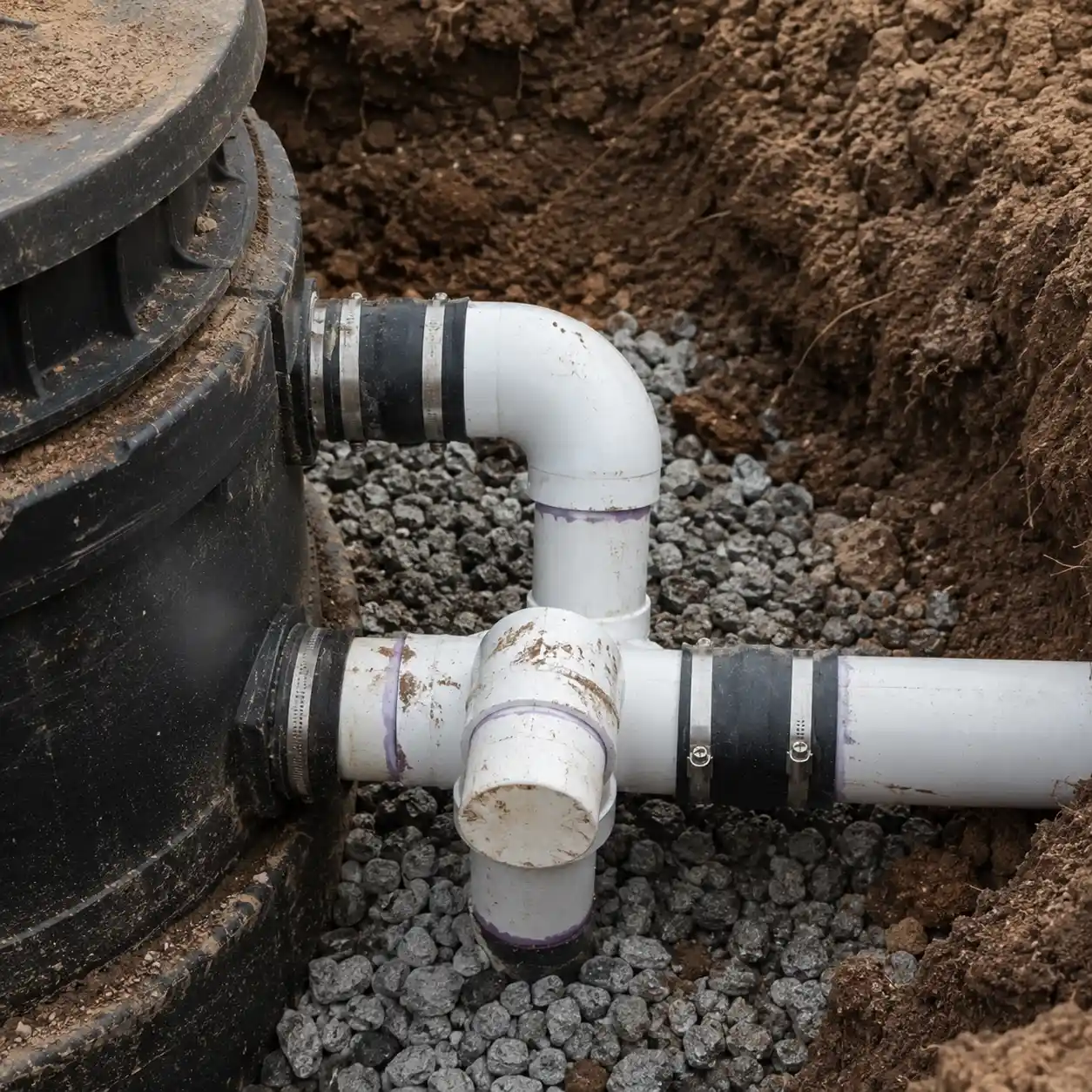
A Blocked Main Line Between the House and Tank
Root intrusion into the main line running from your house to the tank is a genuine possibility on older properties, especially ones with mature trees nearby. Roots seek out the moisture inside the pipe and can partially or fully block flow at the joints, and a large volume like a washing machine’s discharge is often what makes a partial blockage suddenly noticeable.
Gurgling that won’t quit?
We’ll find out whether it’s the pipes or the tank.
Schedule a System Check
Serving Reading and all of Greater Reading.
How to Narrow It Down Yourself First
Run the washing machine on its own, with nothing else using water, and listen for which fixtures react. If it’s only the one toilet closest to the washer, that points toward a localized issue in the shared line rather than something at the tank or field level. If multiple fixtures across the house react — a different bathroom, a floor drain, a basement fixture — that’s a stronger signal the problem is downstream, closer to the tank or field.
Next, think about timing. If this started suddenly after years of no issue, ask what changed — a new appliance, a change in household size, or simply enough time passing that the tank is due for pumping. If it’s been a gradual worsening over weeks or months, that pattern fits a drain field or main line issue more than a one-time clog.
When to Stop Guessing and Get It Looked At
If it’s been more than three years since your last pumping, that’s worth checking regardless of what else you find, since it’s the simplest thing to rule out and one of the more common underlying causes. If you’ve also noticed slow drains elsewhere, a wet spot outside, or any odor, don’t wait on a vent stack theory to prove itself wrong — those combined signs point toward the tank or field, and a direct inspection is faster than trial and error.
A proper evaluation starts with measuring where your tank actually stands, checking the main line for obstructions, and confirming whether the drain field is accepting water the way it should. That tells you definitively whether you’re looking at a plumber’s fix or a septic issue — and it’s usually a lot less expensive than guessing wrong and paying for the wrong repair first.
Get to the Bottom of the Gurgling
Tell us what you’ve noticed and when it started, and we’ll follow up to schedule an evaluation.
- Main line and drain check
- Tank level measurement
- Drain field function check
- Written findings before any repair
- Serving all of Greater Reading
Tell Us About Your Needs
We’ll reach out to confirm your appointment details.