Sewage Smell Outside But No Backup Inside: Is This Serious?
Nothing’s backing up in the house, drains seem fine, but there’s an unmistakable smell outside near the tank or yard. Here’s what that specific combination usually means and what to check first.
Why This Isn’t the Same as an Emergency
An outdoor odor with no indoor symptoms is genuinely a different situation than a backup, and it’s worth saying plainly: this usually isn’t an emergency in the sense of needing service within the hour. But “not an emergency” doesn’t mean “ignore it.” An outdoor smell without indoor symptoms often means the problem is happening outside — at the tank, the vent, or the drain field — before it’s progressed far enough to affect anything inside the house.
That’s actually useful information. It narrows down where to look, and it means you’re catching something before it becomes the kind of problem that does show up inside. Here’s how to work through the possibilities in order, starting with the simplest.
Step 1: Check the Weather and Wind
Before assuming a problem, rule out the boring explanation. Septic tanks vent gas through a roof vent pipe by design — that’s normal and expected. On humid days, after rain, or when wind is blowing from a certain direction, that normal venting can be more noticeable than usual near the house. If the smell is faint, comes and goes with the weather, and isn’t localized to one specific spot, it may simply be normal venting on a day when conditions carry it toward you rather than away.
Step 2: Walk the Area and Pinpoint the Source
If the smell isn’t weather-related, figure out exactly where it’s strongest. Walk the perimeter of your yard, paying particular attention to the area over the tank and the drain field. A smell concentrated in one specific spot — especially if it’s consistently the same spot day after day — points toward something localized rather than general venting.
While you’re out there, look at the ground itself. Is it damp or unusually green in that same area? A localized smell paired with damp or lush ground is a stronger combination than either sign alone, and it usually points toward the drain field specifically.
Step 3: Check the Tank Access Lid
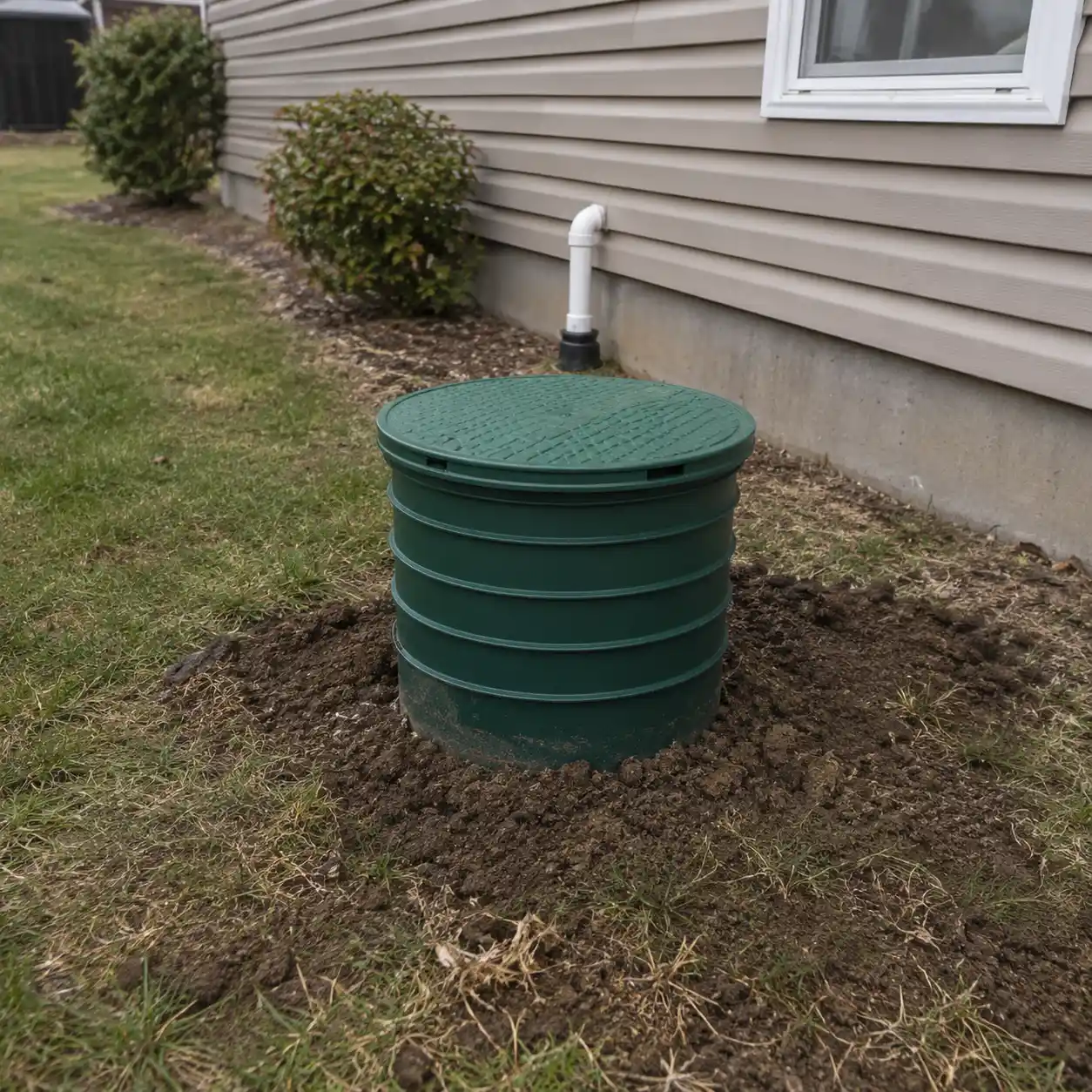
If you know where your tank access lid is and it’s easily reachable, take a look — not to open it, just to check that it’s properly sealed and undamaged. A lid that’s cracked, sitting loose, or wasn’t resealed properly after a past service visit is a straightforward, fixable cause of an odor concentrated right at that spot. This is common enough after a DIY project or a service visit from years ago that didn’t reseal things as tightly as it should have.
Step 4: Think About Timing Since Your Last Pumping
If it’s been more than three years, or you genuinely don’t know when the tank was last serviced, that’s worth factoring in regardless of what else you’ve found. A tank that’s approaching capacity can produce more noticeable odor even before any visible symptoms appear, since gas buildup and scum layer thickness both increase as the tank fills.
Step 5: Rule Out the Drain Field as the Source
If the smell traces to the field rather than the tank itself, that’s a more significant finding. It usually means effluent isn’t filtering through the soil the way it should — either from a distribution box issue sending too much water to one area, or broader saturation across the field. In Berks County specifically, the limestone-based karst geology in the central and western part of the county, along with high water tables near creeks and the Schuylkill River, both make this more likely than in flatter, better-draining regions.
Smell that won’t go away?
We’ll pinpoint the source before it becomes a bigger problem.
Schedule an Evaluation
Serving Reading and all of Greater Reading.
Why It’s Worth Addressing Even Without Indoor Symptoms
The pattern we see most often is that outdoor-only symptoms come first, and indoor symptoms come later — sometimes weeks or months later, once the underlying issue has had time to progress. A distribution box problem sending effluent to the surface in one spot, left alone, can eventually saturate a larger section of the field. A tank nearing capacity, left alone, eventually pushes solids toward the field itself.
In both cases, catching it at the outdoor-only stage is meaningfully cheaper and less disruptive than waiting until it affects the house. A distribution box repair is a fraction of the cost of a drain field replacement, and a routine pump-out is a fraction of the cost of dealing with solids that have already reached the field.
What an Evaluation Actually Involves
A direct look confirms what your own walkthrough can only suggest — measuring tank levels, checking the distribution box, and assessing whether the drain field is accepting water properly. That takes the guesswork out of it and tells you specifically whether you’re dealing with a sealed-lid fix, an overdue pumping, a distribution box repair, or something at the field level that needs more attention.
Track Down the Odor
Tell us where the smell is strongest and how long it’s been happening, and we’ll follow up to schedule a look.
- Tank lid and seal check
- Tank level measurement
- Distribution box inspection
- Drain field function check
- Serving all of Greater Reading
Tell Us About Your Needs
We’ll reach out to confirm your appointment details.