How to Find Your Septic Tank When There Are No Records
No paperwork, no idea where to even start digging — a common situation on older Berks County homes. Here’s a methodical way to narrow it down before you call anyone with a probe.
Why This Happens So Often Around Here
The common assumption is that every septic system has a permit on file somewhere, and you just need to track down the right office. In practice, that’s often not true for older properties. Pennsylvania didn’t always require the kind of detailed permitting and record-keeping that’s standard today, and a lot of Berks County’s older in-town and rural housing predates current township oversight entirely. Add in a few changes of ownership, and paper records that may have existed once are long gone.
The good news is that a missing record doesn’t mean you’re starting from nothing. There’s a logical process for narrowing down a tank’s location using clues that are usually still there, even decades later.
Step 1: Check With Your Township First, Just in Case
Before assuming there’s nothing on file, it’s worth a quick call to your township office anyway. Septic permitting in Pennsylvania runs through each municipality’s Sewage Enforcement Officer under the state’s Act 537 Sewage Facilities Act, and some townships have digitized older records that weren’t easy to find in the past. It’s a five-minute call that occasionally saves you the entire rest of this process.
Step 2: Find Where the Main Line Exits the House
In your basement or crawlspace, locate the main sewer line — the largest pipe, typically 4 inches in diameter, that carries wastewater out of the house. Note which wall it exits through. The tank is almost always positioned along the path that pipe travels outward from the house, which immediately cuts your search area from “the whole yard” down to a rough line extending from that exit point.
Step 3: Estimate the Distance
Septic tanks are typically installed 10 to 25 feet from the foundation, close enough to keep the connecting pipe short but far enough to satisfy setback requirements. Older installations sometimes sit closer to that 10-foot mark; larger properties with more room to work with may be further out. Combined with the direction from Step 2, you’re now looking at a specific, walkable zone rather than an entire yard.
Step 4: Look for Surface Clues in That Zone
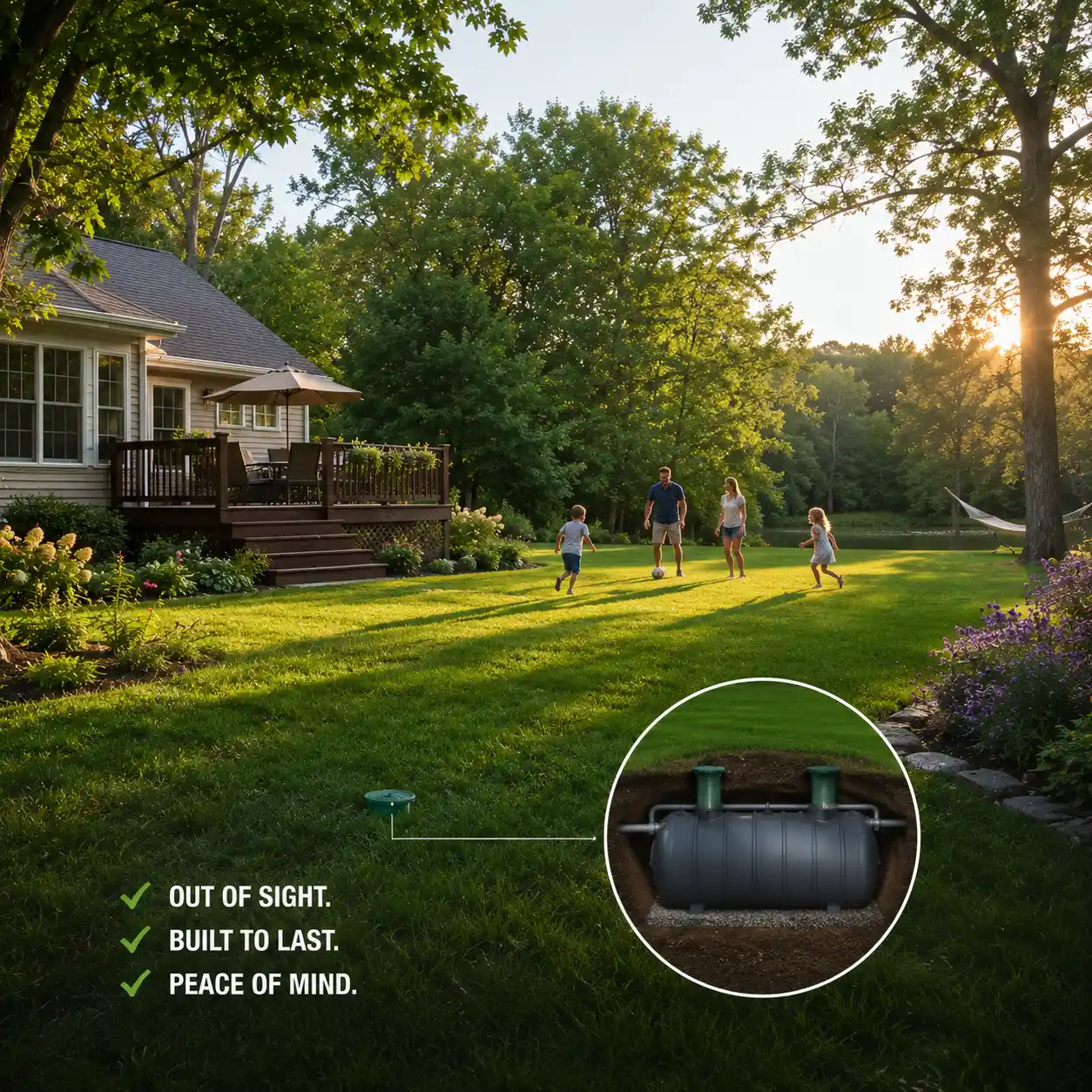
Once you’ve narrowed the search area, walk it slowly and look for a few telltale signs. A slightly raised or slightly sunken rectangular patch of lawn is common, since the soil above a tank settles differently than surrounding ground over time. Grass that grows faster or a different shade of green over one section can also mark the spot, especially in warm months. Older properties sometimes have a visible round concrete or metal access lid, occasionally covered by a thin layer of soil or grass that’s grown over it.
Step 5: Check for a Vent or Riser Pipe
Some installations include a small vertical pipe rising above ground level near the tank, sometimes overgrown or mistaken for a stray piece of plumbing left behind by a previous project. If you spot anything like this in your estimated search zone, it’s a strong indicator of the tank’s location beneath it.
Step 6: Bring in Probing Rods for the Final Confirmation
Once you’ve narrowed things down using the steps above, a thin metal probing rod pushed carefully into the soil can confirm the tank’s edges by feel — solid concrete or plastic feels distinctly different from soil once you hit it. This is the point where it’s worth having someone experienced do the probing rather than doing it yourself, especially on any property with karst-prone ground, where bedrock can sit closer to the surface than expected and make interpreting what you’re feeling more difficult.
Rather not dig around blind?
We locate tanks with no records on a regular basis.
Schedule a Locate & Pumping Visit
Serving Reading and all of Greater Reading.
Why We Don’t Just Start Digging
On any Berks County property, and especially on karst-prone ground in the central and western part of the county, we treat probing as a careful, methodical process rather than trial-and-error digging. Uneven bedrock depth means what feels like an obstruction a few inches down could be rock rather than the tank itself, and misreading that can send a search in the wrong direction entirely — or worse, lead to digging somewhere that shouldn’t be disturbed.
Once we’ve confirmed the tank’s location and exposed the access lid, we can move directly into a pumping visit if one’s due — no need for a separate trip once the hard part is done. And once we’ve located it the first time, that information gets documented so you’re never starting from zero again.
A Practical Tip for the Future
Once your tank’s location is confirmed, take a few photos referencing fixed landmarks — distance from a corner of the house, a specific tree, a fence post — and keep them somewhere easy to find, like with your other home records. It sounds obvious, but it’s the single easiest way to make sure the next person dealing with this system, even if that’s a future you, doesn’t have to go through this whole process again.
Let Us Find It For You
Tell us your address and roughly when the house was built, and we’ll follow up to schedule a locate visit.
- Methodical, karst-aware probing
- Combined locate and pumping visit
- Location documented for future reference
- No unnecessary digging
- Serving all of Greater Reading
Tell Us About Your Needs
We’ll reach out to confirm your appointment details.